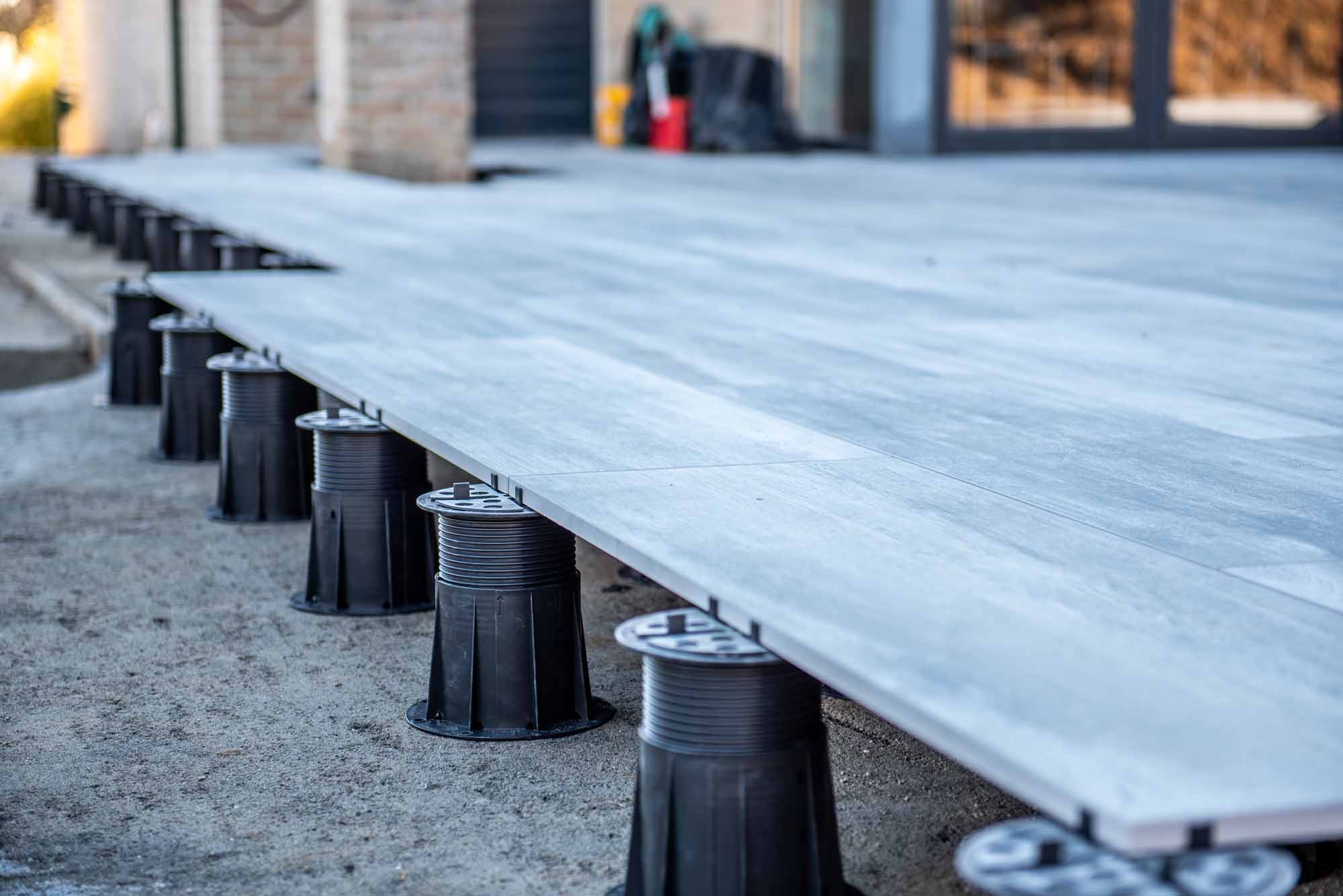
Preparing a pedestal terrace project: the technical information needed to choose the right Buzon pedestals and accessories

In a pedestal terrace project, the quality of technical advice depends directly on how accurate the information provided upstream is. For architects, contractors, specifiers, landscape designers and distributors, properly defining a project makes it easier to recommend the right pedestals and accessories, reduce uncertainty and secure the installation process.

No two projects have the same constraints. Dimensions, surfacing, slope, heights, finishes and specific site conditions all play a role in selecting the right solution. Here are the main pieces of information to gather in order to guide the choice of Buzon pedestals and accessories correctly.

1. Terrace dimensions

The overall dimensions of the terrace are the first piece of information to provide. They make it possible to establish an initial estimate of the number of pedestals required and better define the scale of the project.

However, this information alone is not enough. To obtain a reliable recommendation, it must be complemented by more detailed information about the surfacing, the substrate and site-specific constraints.

2. Slab or surfacing dimensions

The size of the slabs or surfacing elements is essential for refining the layout plan and sizing the system correctly. It helps determine more precisely how many pedestals are needed and where they should be positioned.

This information is essential to:

  • avoid underestimating or overestimating quantities;
  • anticipate support points;
  • ensure proper load distribution;
  • adapt the solution to the surfacing format.

In a professional context, this step helps make the technical assessment more reliable and the installation better prepared.

3. Slab thickness

The thickness of the surfacing is a key criterion when checking compatibility with pedestal installation. Requirements may vary depending on the material used.

For example:

  • for ceramic slabs, a minimum thickness of 20 mm is required;
  • for natural stone or concrete slabs, a thickness greater than 20 mm is generally necessary.

It is therefore important to have the exact technical characteristics of the surfacing available, or to confirm them with the supplier if needed. This verification helps secure the system choice and ensure compliant installation.

4. Joint spacing

The planned spacing between slabs affects the choice of spacers, especially PB-TABS. While 3 mm is the most common size, several options are available depending on project requirements and the desired finish.

Providing this information in advance makes it possible to:

  • select the right accessories;
  • ensure visual consistency across the surfacing;
  • achieve a finish aligned with project expectations.

Although it may seem like a minor detail, it directly affects the perceived quality of the completed terrace.

5. Substrate slope

The slope of the substrate is a major technical factor in choosing pedestals and complementary accessories. Depending on the project, the slope may either be maintained or corrected.

If the terrace is intended to follow the natural slope of the substrate, a slope corrector is not required. However, if the goal is to create a perfectly level surface, a slope corrector such as the U-PH5 will be needed, along with pedestals of different heights to compensate for level differences.

Taking the slope into account helps to:

  • secure the stability of the surfacing;
  • improve finishing quality;
  • ensure consistent level management;
  • avoid certain installation errors.

6. Start and end heights

In projects where the slope must be corrected, the start and end heights of the terrace are particularly important. They make it possible to determine more precisely which pedestal models are required, from PB-0-S12 to PB-12, depending on the site configuration.

These measurements are essential to:

  • match pedestal selection to the actual configuration;
  • anticipate level variations;
  • ensure smoother installation on site;
  • reduce unexpected adjustments during execution.

For professionals, having this information available during the design phase represents a real time saver.

7. Technical constraints and specific site conditions

Every site has its own particularities. The presence of an inspection hatch, a post, a tree, a specific angle or irregularities in the substrate should be identified from the outset.

These constraints may require specific solutions, such as:

  • using U-PAD pads to compensate for certain irregularities;
  • specific cut-outs or adjustments;
  • accessories suited to non-standard configurations;
  • dedicated thinking around finishes or accessibility.

Identifying these points early makes it possible to tailor the technical solution more effectively to the reality of the project.

8. Type of finish

Finally, the desired type of finish will also influence the choice of accessories. Edge details, connections to vertical elements and the treatment of sensitive areas all need to be considered to ensure a coherent and well-executed final result.

For example:

  • for a finish against a wall, a U-WALL wall spacer may be required;
  • for small edge slabs, the U-EDGE may be more suitable;
  • to create a coordinated perimeter finish, the PB-END terrace finishing kit allows slabs to be fixed vertically using hooks attached to the top and base of the pedestal.

In a professional project, the quality of the finishing details plays an important role in the overall perception of the work. Anticipating these needs at specification stage helps avoid late adjustments.

Better project definition leads to a better solution

In a pedestal terrace project, the accuracy of the technical information provided directly affects the relevance of the advice and the efficiency of the proposed solution. The better the project is defined upstream, the easier it becomes to recommend the right Buzon pedestals and accessories for the site configuration.

Dimensions, surfacing thickness, slope, levels, technical constraints and finishes all help guide system selection more accurately, facilitate installation and secure the final result.

For professionals, this preparation phase is an essential step in designing durable terraces that are well executed and perfectly suited to the project requirements.