5. Substrate slope
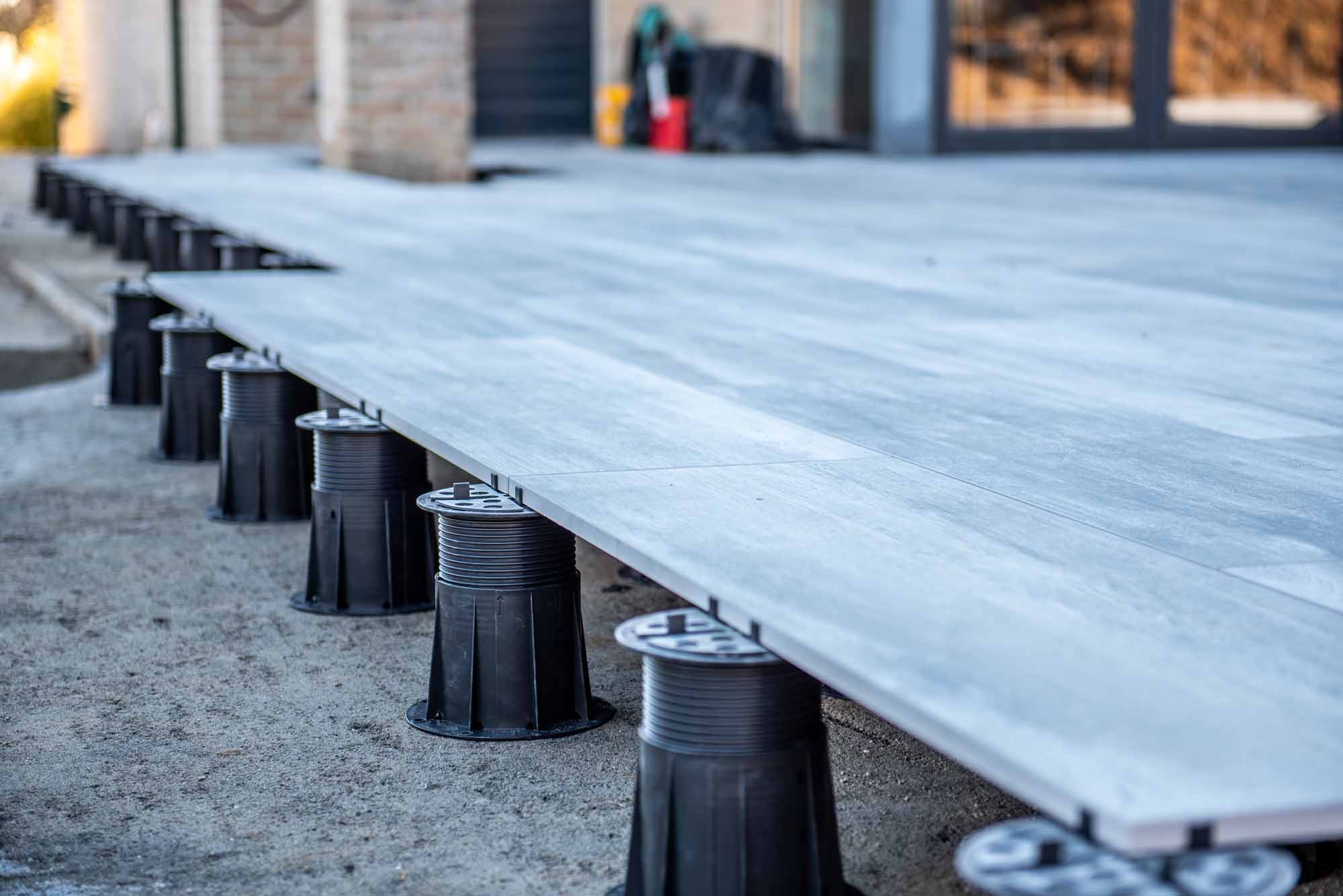
The slope of the substrate is a major technical factor in choosing pedestals and complementary accessories. Depending on the project, the slope may either be maintained or corrected.
If the terrace is intended to follow the natural slope of the substrate, a slope corrector is not required. However, if the goal is to create a perfectly level surface, a slope corrector such as the U-PH5 will be needed, along with pedestals of different heights to compensate for level differences.
Taking the slope into account helps to:
- secure the stability of the surfacing;
- improve finishing quality;
- ensure consistent level management;
- avoid certain installation errors.
6. Start and end heights
In projects where the slope must be corrected, the start and end heights of the terrace are particularly important. They make it possible to determine more precisely which pedestal models are required, from PB-0-S12 to PB-12, depending on the site configuration.
These measurements are essential to:
- match pedestal selection to the actual configuration;
- anticipate level variations;
- ensure smoother installation on site;
- reduce unexpected adjustments during execution.
For professionals, having this information available during the design phase represents a real time saver.
7. Technical constraints and specific site conditions
Every site has its own particularities. The presence of an inspection hatch, a post, a tree, a specific angle or irregularities in the substrate should be identified from the outset.
These constraints may require specific solutions, such as:
- using U-PAD pads to compensate for certain irregularities;
- specific cut-outs or adjustments;
- accessories suited to non-standard configurations;
- dedicated thinking around finishes or accessibility.
Identifying these points early makes it possible to tailor the technical solution more effectively to the reality of the project.
8. Type of finish
Finally, the desired type of finish will also influence the choice of accessories. Edge details, connections to vertical elements and the treatment of sensitive areas all need to be considered to ensure a coherent and well-executed final result.
For example:
- for a finish against a wall, a U-WALL wall spacer may be required;
- for small edge slabs, the U-EDGE may be more suitable;
- to create a coordinated perimeter finish, the PB-END terrace finishing kit allows slabs to be fixed vertically using hooks attached to the top and base of the pedestal.
In a professional project, the quality of the finishing details plays an important role in the overall perception of the work. Anticipating these needs at specification stage helps avoid late adjustments.